Choosing between a pergola and a covered patio can completely change how your backyard looks, feels, and functions.
Both options can add shade, define an outdoor living space, and create a more comfortable place to relax or entertain. However, they do not provide the same level of protection, cost, flexibility, or visual impact.
The right choice depends on how you plan to use the space, how much shade you need, whether you want protection from rain, your budget, and the overall style of your home.
For homeowners planning an outdoor living space in El Paso, sun exposure and heat are especially important factors to consider.
What Is a Pergola?
A pergola is an outdoor structure made with vertical posts or columns that support an open or partially open roof.
The top is usually made with beams, rafters, or slats that create partial shade while still allowing sunlight and air to pass through.
Pergolas are commonly built over patios, seating areas, outdoor kitchens, walkways, or poolside spaces.
They can be freestanding or attached to the house.
A pergola is usually a good option when the goal is to create visual structure and some shade without completely covering the space.
What Is a Covered Patio?
A covered patio is an outdoor area with a solid roof designed to provide more complete protection from sun and weather.
The roof may be attached directly to the home or supported by its own columns.
Covered patios can use different roofing materials and can be designed to match or complement the architecture of the house.
Because the roof is solid, a covered patio generally provides more consistent shade and better protection from rain than a traditional pergola.
This makes it a popular option for homeowners who want to use their backyard more frequently throughout the year.
Pergola vs. Covered Patio: The Main Differences
Although both structures improve outdoor living areas, there are several important differences between them.
| Feature | Pergola | Covered Patio |
|---|---|---|
| Shade | Partial | Full or nearly full |
| Rain protection | Limited | Much better |
| Airflow | Very open | More enclosed overhead |
| Natural light | High | Lower |
| Visual style | Light and decorative | More substantial |
| Typical construction | Beams or slats | Solid roof |
| Ideal use | Relaxing, landscaping, decorative shade | Dining, outdoor kitchens, everyday use |
Neither option is automatically better.
The right structure depends on what you need from your backyard.
Which Option Provides More Shade?
A covered patio provides more dependable shade.
Because the roof is solid, it blocks direct sunlight throughout the covered area.
A pergola creates filtered shade instead.
Its beams or slats block some sunlight while allowing light to pass between them.
This can create a comfortable balance between sun and shade, but it may not be enough in areas that receive intense direct sunlight for several hours each day.
For outdoor spaces in El Paso, where strong sun can make uncovered patios uncomfortable, the amount of shade should be one of the first factors considered.
If complete shade is the priority, a covered patio may be more practical.
If you still want natural light and an open-air feeling, a pergola may be a better fit.
Which Is Better for an Outdoor Kitchen?
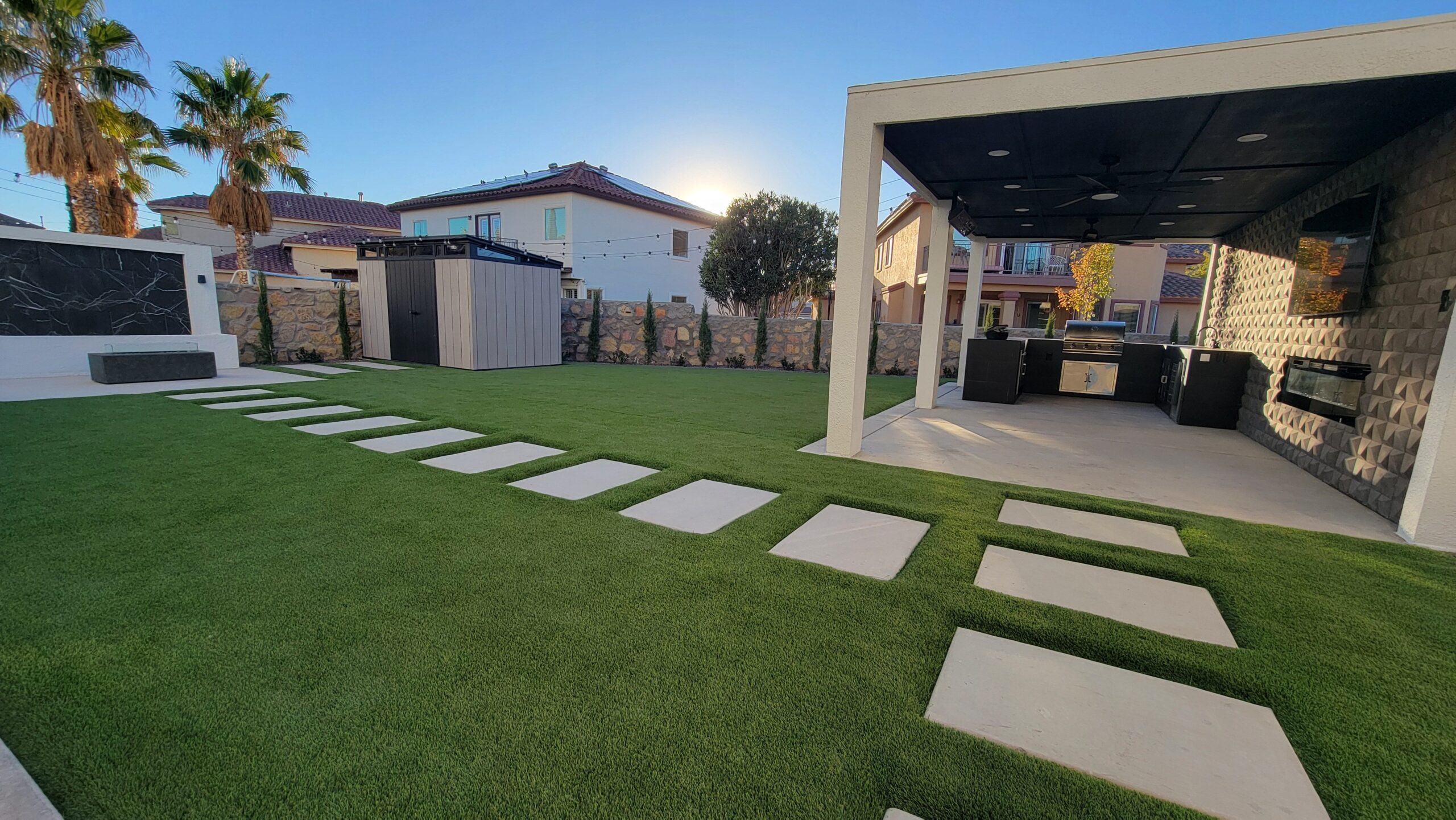
A covered patio is often the more practical option for a full outdoor kitchen.
The solid roof can help protect appliances, countertops, seating, and cooking areas from direct sun and some weather exposure.
It can also make the cooking area more comfortable during hot afternoons.
However, a pergola can still work well for a smaller backyard kitchen or grilling station, especially when the homeowner prefers an open design.
The final design should consider ventilation, cooking equipment, appliance clearance requirements, and how heat and smoke will move through the structure.
If an outdoor kitchen is a major part of the project, it is usually best to plan the shade structure and cooking area together.
Which Option Works Better for Entertaining?
Both can work well for entertaining, but they create different experiences.
A pergola often feels more casual and open.
It can define a seating or dining area without making the backyard feel enclosed.
This makes it a good option for:
- Lounge areas
- Small dining spaces
- Poolside seating
- Garden areas
- Fire pit seating
A covered patio creates a more protected gathering space.
It may be better for homeowners who frequently host guests and want a dependable place for:
- Outdoor dining
- Large seating areas
- Televisions
- Outdoor kitchens
- Bars
- Family gatherings
If entertaining is one of the main reasons for improving the backyard, think about how many people usually use the space and what activities take place there.
How Much Weather Protection Do You Need?
This is one of the biggest differences between a pergola and a covered patio.
A traditional pergola provides limited protection from rain because of its open roof.
Even closely spaced slats do not create a completely waterproof surface.
A covered patio can provide significantly better protection.
This can help keep outdoor furniture, cooking areas, and entertainment equipment more protected.
However, roof design, drainage, wind direction, and the openness of the sides still affect how much protection the patio provides.
If your goal is to create an outdoor area that remains usable during different weather conditions, a covered patio generally offers more flexibility.
Which Option Feels More Open?
Pergolas usually create a more open feeling.
Because the roof is partially open, they allow more daylight, airflow, and visibility.
This can be especially useful in smaller backyards where a solid structure might make the space feel heavier.
Covered patios create a stronger visual boundary between the covered area and the rest of the backyard.
That can be beneficial when you want the patio to feel like an extension of the indoor living space.
The choice often comes down to whether you prefer a light, open structure or a more defined outdoor room.
Which One Fits Better With Your Home?
Both structures can be designed to complement different architectural styles.
Pergolas can work particularly well with modern, Mediterranean, southwestern, and contemporary homes.
Materials, beam spacing, column design, and finishes can all change the appearance.
Covered patios can also be highly customized.
The roofline can often be designed to coordinate with the existing home, helping the new structure feel more integrated.
Before building either option, consider:
- The roofline of the house
- Exterior colors
- Existing materials
- Patio flooring
- Landscaping
- Window placement
- Backyard proportions
A structure that looks attractive on its own may still feel out of place if it is not coordinated with the rest of the property.
Pergola vs. Covered Patio Cost
The cost of a pergola or covered patio varies widely depending on size, materials, site conditions, structural requirements, and customization.
In many cases, a basic pergola may require less construction than a full covered patio because it does not include a solid roof system.
However, custom pergolas with premium materials, lighting, electrical features, or complex designs can still represent a significant investment.
A covered patio may involve additional structural, roofing, drainage, and electrical work.
Instead of comparing only the starting cost, think about how much use you expect to get from the space.
A structure that better matches your lifestyle may provide more value even if the initial project is more involved.
What About Maintenance?
Maintenance depends heavily on the materials used.
Wood pergolas may need periodic staining, sealing, or painting.
Metal structures can require less maintenance but may still need cleaning and inspection over time.
Covered patios also require maintenance of the roof, drainage system, structural components, and finishes.
When selecting materials, consider:
- Sun exposure
- Moisture
- Dust
- Temperature changes
- Cleaning requirements
- Long-term durability
For El Paso homeowners, selecting materials that can handle strong sun and outdoor exposure is especially important.
Can You Add Lighting to a Pergola or Covered Patio?
Yes.
Both structures can support outdoor lighting and electrical features when they are planned correctly.
Common lighting options include:
- Pendant lights
- Ceiling lights
- String lights
- Recessed lighting
- Under-beam lighting
- Wall lights
- Accent lighting
Covered patios can also make it easier to integrate ceiling fans, televisions, speakers, and other electrical features.
Pergolas can create a more decorative lighting effect because lights can be installed along beams or rafters.
Electrical requirements should be planned before construction whenever possible.
Can You Add Fans?
Fans are easier to integrate into many covered patio designs because the solid roof creates a more traditional overhead structure.
Depending on the design, fans can also be installed in some pergolas.
This can be especially useful in hot climates where airflow makes the outdoor space more comfortable.
Before installation, make sure the structure is designed to support the fan and that electrical components are rated for outdoor use.
Which Option Is Better for a Small Backyard?
A pergola can be an excellent choice for a small backyard because it defines an area without visually closing it off.
The open structure allows light and views to continue through the space.
A covered patio may still work well in a small yard, especially if the goal is to create a highly functional dining or cooking area.
The important thing is to keep the scale proportional to the property.
A structure that is too large can overwhelm the backyard and reduce open space.
Which Option Is Better for a Large Backyard?
Larger properties often provide more flexibility.
A covered patio can create a substantial outdoor living area connected to the house, while a pergola can define a separate destination farther into the backyard.
Some homeowners use both.
For example, a covered patio may contain the outdoor kitchen and dining area, while a pergola creates a separate seating space near a pool, garden, or fire pit.
The best approach depends on how different sections of the backyard will be used.
Pergola Advantages
A pergola may be the right choice if you want:
- Partial shade
- More natural light
- An open-air feeling
- A decorative backyard feature
- A defined seating or dining area
- A structure that does not visually dominate the yard
- Flexible placement within the backyard
Pergolas can also work well with landscaping and climbing plants when the design allows for them.
Covered Patio Advantages
A covered patio may be better if you want:
- More complete shade
- Better rain protection
- A comfortable outdoor dining area
- Space for an outdoor kitchen
- Protection for furniture and appliances
- Ceiling fans or integrated lighting
- An outdoor living area that feels connected to the home
It is often the stronger option when the outdoor area will be used frequently and needs consistent protection.
Pergola or Covered Patio: Questions to Ask Before Deciding
Before choosing, consider these questions:
- How much direct sunlight does the area receive?
- Do you want full or partial shade?
- Will the space be used primarily for relaxing, dining, or cooking?
- Do you need protection from rain?
- Will you install an outdoor kitchen?
- Do you want ceiling fans or lighting?
- How large is the backyard?
- Do you want the structure attached to the house?
- How much maintenance are you comfortable with?
- Which design better matches the architecture of your home?
Your answers will help determine which structure is more practical for your property.
Can a Pergola Be Covered Later?
In some cases, homeowners add shade panels, fabric, retractable covers, or roofing systems to an existing pergola.
However, the original structure must be designed to support whatever is added.
Adding a solid roof later can change structural loads, drainage requirements, and wind resistance.
If there is a strong possibility that you will want complete coverage in the future, it may be better to plan for it during the initial design.
Should the Structure Be Attached or Freestanding?
Both pergolas and covered patios can be attached or freestanding.
An attached structure can create a smoother transition between indoor and outdoor spaces.
This is often useful for dining areas and outdoor kitchens.
A freestanding structure gives you more flexibility in choosing the location.
It may work better near:
- Pools
- Gardens
- Fire pits
- Detached seating areas
- Large open yards
The best placement depends on traffic flow, existing landscaping, sun exposure, and how the backyard is used.
Pergola vs. Covered Patio in El Paso
For homeowners in El Paso, the decision often comes down to sun protection and intended use.
A pergola can be a good fit when you want filtered shade and an open design.
A covered patio may be more suitable when you want stronger protection from direct sunlight and a space that can comfortably support dining, entertainment, or an outdoor kitchen.
Because every backyard receives sunlight differently, it is helpful to consider the orientation of the home and how the area changes throughout the day.
A structure that works well on one property may not provide the same comfort on another.
Which Is Better for Your Outdoor Space?
A pergola is usually the better choice if you want a visually open structure, partial shade, and a defined backyard feature without creating a fully covered area.
A covered patio is often better when you want maximum shade, more weather protection, and a space that can function more like an outdoor room.
The best choice depends on your backyard, budget, lifestyle, and how often you plan to use the area.
Before building, consider the entire outdoor living design rather than focusing only on the structure itself.
Think about how the pergola or covered patio will connect with seating, landscaping, outdoor kitchens, pools, flooring, walkways, and other backyard features.
Plan Your Outdoor Living Space With Anson General Contracting
A well-designed shade structure can make your backyard more comfortable and functional while creating a natural place for cooking, dining, relaxing, and entertaining.
Whether you are considering a pergola, covered patio, or a larger backyard remodeling project in El Paso, Anson General Contracting can help you plan an outdoor space around the way you use your property.
Contact Anson General Contracting to discuss your backyard project and explore the right structure for your outdoor living space.